
Industrial Design (MFA)
A degree project provides 30 credits and is equivalent to 20 weeks of full-time study. You must have passed at least 65 credits that may be included in the degree in order to commence work on the degree project. The degree project is an independent project and is to be executed individually or in groups of two. Company connections are welcome (discuss with supervisor and examiner).
The degree project is to include the following assessed components:
- project documentation including a short summary in English,
- an oral presentation of the degree project at a public seminar at the Faculty of Engineering,
- an oral and written critical review of another student's degree project at a public seminar where it is presented.
See full course description for more information (Course website LTH)
General information
The aim of the degree project is for you to develop and demonstrate the ability to practise knowledge acquired during your education and the skills to work independently as an industrial designer.
Knowledge and understanding
- demonstrate knowledge and understanding in the field of design, including both broad knowledge of the field and a considerable degree of specialised knowledge in certain areas of the field and
- demonstrate familiarity with methods and processess for dealing with complex phenomena, issues and situations in the field of design.
Competences and skills
- demonstrate the ability to formulate new issues autonomously and creatively and contribute to the formation of knowledge, solve more advanced problems, develop new forms of personal expression as well as to reflect critically on his or her artistic approach and that of others in the main field of study,
- demonstrate the ability to create and execute his or her own ideas with his or her own personal expression, to identify, formulate and solve artistic and creative problems autonomously and also to plan and undertake advanced artistic tasks using appropriate methods within both national and international contexts and
- demonstrate the competence and knowledge required to work autonomously with other parties in a professional capacity.
Judgement and approach
For a pass on the course, the student shall demonstrate the ability to make assessments in the field of design informed by relevant artistic, social and ethical issues.
You have the responsibility and freedom to find a suitable topic for the degree project which has to be approved by the examiner and a supervisor at the division of industrial design. The topic and structure for the degree project must be devised and planned.
The cover page of any project documentation must feature the Lund University (LU) or LTH logo as well as the name of the author and the title of the project. The logo(s) can be obtained from the image and media bank at Lund university's website.
Image and Media Bank, Lund University
On the title page behind the cover page:
- Title (subtitle)
- Author’s name
- Degree Project for Master of Fine Arts in Design, Main Field of Study Industrial Design, from Lund University, School of Industrial Design
- Department of Design Sciences
- Name and title of examiner
- Name and title of supervisor(s)
- Name(s) and title(s) or position(s) of external supervisor(s)/contributor(s)
- Copyright year (and if applicable Print year*)
*If the work was conducted in a year prior to the year the report was printed, this needs to be clearly stated in the documentation.
As stated in the course syllabus, it is obligatory to make an oral and written critical review of another student’s degree project at a public seminar where it is presented. It is the responsibility of each Degree student to select a project to review and make sure you get the documentation in time to prepare. NB. it is obligatory to review a project but not obligatory to have one’s project reviewed. Two people may not review each other’s projects, there must be an off-set of at least three.
The goal is not to judge the work but rather to give support through constructive criticism, both positive and negative, in order to improve the work (guidelines below). The written review, with any additional notes from the presentation, should be sent to your peer, supervisor and examiner after the presentation.
Reading Guidelines These are guidelines used to support critical reading and to present relevant feedback (also good for reviewing your own work): The documentation should be critically reviewed with respect to its integrity.
- Scrutinise the goal(s) and motivations presented in the project documentation; do they correspond to the results and conclusions?
- Is the brief properly formulated? Does the design process represent the outcome?
- Inspection of the suitability of the process. Could it be carried out in an alternative way
- Are the demarcations reasonable?
- Is the design process been clearly documented?
- Motivation
- Analysis
- Synthesis
- Evaluation
- Realisation
- Are there parts that need to be expanded? Are there parts that are redundant?
- Are tables, formulas, diagrams and other illustrations (sketches, mock-ups etc.) clear and comprehensible?
- Is the development and evaluation process of the outcome clear and thoroughly described? • What is your own work and what has been inspired or sourced externally?
- Are the conclusions correct?
- Is there something left unexplained? Are there some statements that are wrong or unfounded?
- Are there factual discrepancies to the oral presentation at the seminar?
- Is the reference list correct? Are some references missing or are there unnecessary references?
- Is the grammar and spelling correct?
- Are the formalities correctly stated?
Peer review setup
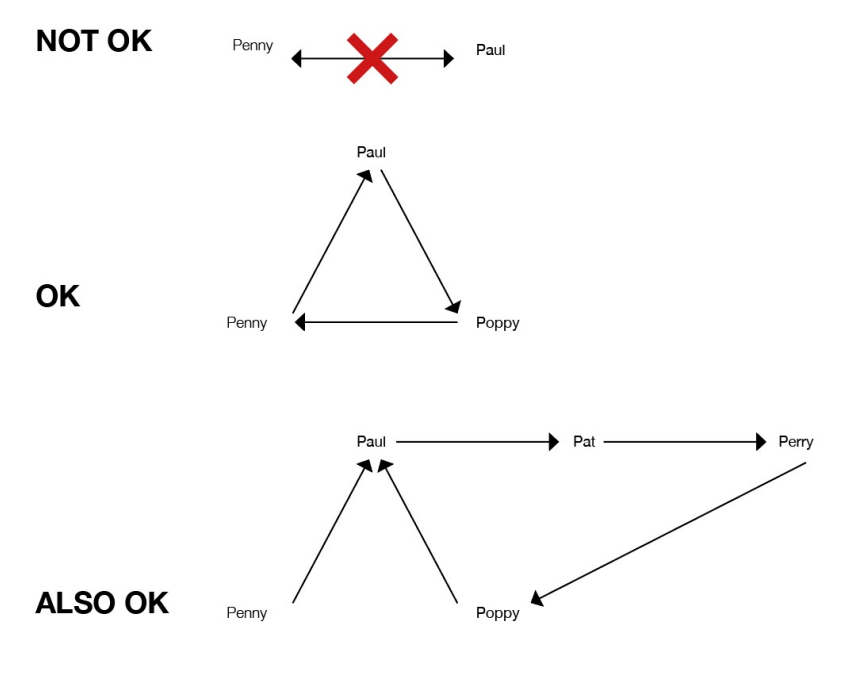
The picture shows that it is not allowed for two people to review eachothers degree projects alone, ie Penny and Paul can not review eachothers degree project. But Penny can review Paul's, Paul can review Poppy's and Poppy can review Penny's as an example.
Degree shows (School of Industrial Design's website)
LUP Student papers (paper copies available at the A-house library)
- Despina Christoforidou, Licentiate
- Claus-Christian Eckhardt, Professor
- Andreas Hopf, Lecturer
- Olof Kolte, Senior Lecturer
- Carl Lidgard, Lecturer
- Anna Persson, Lecturer
- Jasjit Singh, Senior Lecturer
- Charlotte Sjödell, Senior lecturer
- Olof Jansson, Lecturer
- Phillipp Aussem, Lecturer
Assistant Supervisors:
Sheida Amiri Rigi, PhD Student
Riccardo Centazzo, PhD Student
Jaxon Pope, PhD Student
Timeline
- Launch a Degree Project online to get your prerequisites checked.
Online form for Degree Project
- E-mail Olof Kolte stating your project topic along with a short description of the project and expected outcome + preference for Supervisor. Please include a pdf (max 5MB) or link to your portfolio in the communication. (You will be assigned Supervisor with consideration to your preferences, topic and staff resources.)
- Prepare for workshop wtih Daniel Charny on 22 January
- Reach out to your assigned examiner and supervisor(s) to set up a time for the first meeting(s).
- Describe your project and brief in writing, including:
- personal motivation and background
- project plan with important dates (planned research and activities, etc.)
- description of possible project partner and/or cooperations.
- Forward the Digital Enrolment Form. The examiner and supervisor officially approves the brief and time plan by signing the enrolment form.
- Select a project to peer-review – In completion of the degree project, it is mandatory to review another student’s Master’s degree project.
- February 2 - Presentation Check-In (1)
- February 16 - Presentation Check-In (2)
- March 16 - Mid Project presentation
- April 30 - last day to send in preliminary project documentation (80% of the report) prior to the presentation. Send as a pdf to the examiner, supervisor and student reviewer(s)
- May 13 - last day to have final meeting with supervisor and examiner before presentation
- May 18-21 Degree Project Presentations
Procedure for the presentation
- Supervisor introduces / welcomes
- 30 min. presentation (public)
- 10 min. peer review and questions from the audience (public)
- 15 min. colloquium between jury, supervisor(s) and examiner (closed)
- 10 min. feedback session with diploma student (closed)
- (65 min total)
- June 4 Degree Show Opening
- June 4-8 Degree exhibition